Kabbalah and the Tree of Life: a mystical map of creation, the soul, and the way back
Kabbalah describes creation in four worlds and ten sefirot; teacher Yuri de Carvalho reads it as a map for self-knowledge.
· 3 min read · Sources

In 1 minute
- In Kabbalah, divine light unfolds into four worlds, and the human soul is divided into three layers: nefesh, ruach, and neshamah.
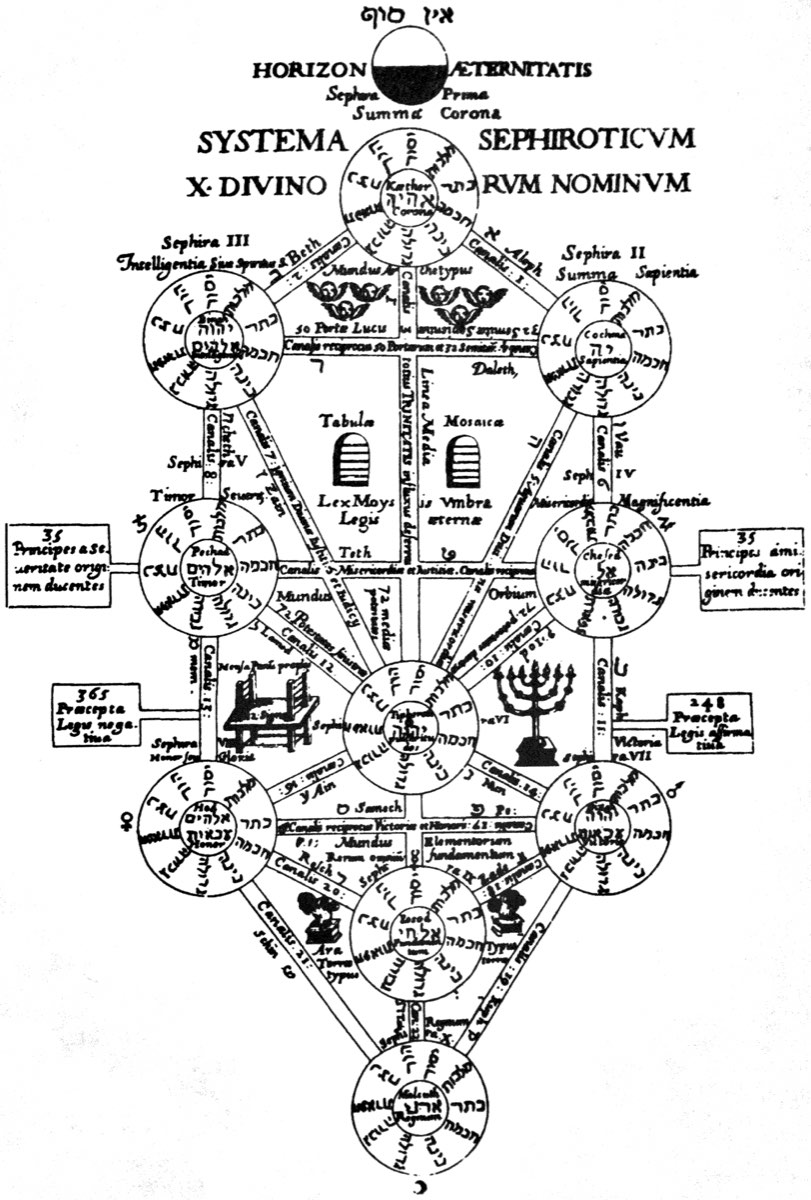
- The Tree of Life gathers ten spheres, the sefirot, into three triads (mental, emotional, and behavioral) that converge in Malkuth, the plane of matter.
- In Yuri de Carvalho's reading, studying the map serves self-knowledge: each sefirah is a lens for recognizing emotions, masks, and potentials.
Full article
Kabbalah means “receiving.” The name comes from the idea that the mystical knowledge of Judaism was received and passed down from generation to generation, and it designates both an esoteric method and a school of thought that seeks to explain how an eternal, limitless God relates to a finite universe. At the center of this system is a diagram of ten interconnected spheres, the Tree of Life.
The tradition was born within Judaism, but Western esotericism absorbed it, giving rise to readings such as Christian Kabbalah and Hermetic Kabbalah. Teacher Yuri de Carvalho, in a series of lectures, lays out a version that combines Hebrew tradition with modern esotericism and Hermetic philosophy. It is one possible interpretation, not a consensus among Kabbalah's various schools, and this piece presents it in those terms.
From primordial light to the four worlds
In the creation story Kabbalah tells, everything originates from the Ein Sof, the “limitless nothing.” From it emerges a primordial light through a process of contraction and emanation called tsimtsum. From this light are born the four kabbalistic worlds: Atzilut, emanation; Beriah, creation; Yetzirah, formation; and Assiah, manifestation.
Each world would correspond to a plane of existence and to a dimension of the soul, which has three layers: nefesh, ruach, and neshamah. The expulsion from the Garden of Eden is read as the distancing of the divine spark that dwells within every being. Upon incarnating in Malkuth, the Kingdom, the soul fragments and forgets its origin. Kabbalah would be the way back: the climb up the Tree.
Ten spheres in three triads
The sefirot are the powers through which the Ein Sof would have manifested its will in the creation of the universe. The word originally means “number” or “count”; the doctrine of the sefirot as divine attributes, a cornerstone of Kabbalah, took shape from the 12th century onward. In Yuri's exposition, they are archetypal forces grouped into three triads.
The mental triad gathers Keter, Chokhmah, and Binah. Keter, the crown, is the point of origin; Chokhmah represents wisdom in its archetypal state; Binah is the form that gives it structure. Between this triad and the manifest world lies the veil of Da'at, knowledge.
The emotional triad brings Chesed, Gevurah, and Tiferet. Chesed is benevolence, which expands, and Gevurah is rigor, which contracts. Tiferet, beauty and harmony, balances the two and is described as the Christic center of the tree.
The behavioral triad joins Netzach, Hod, and Yesod. Netzach, victory, is tied to instincts and nature; Hod, splendor, to the intellect; Yesod, foundation, to the ego, social masks, and contact with the physical world.
The three converge in Malkuth, the densest plane. It is also the point of return, because, in this reading, every Keter would be a Malkuth, and every Malkuth, a Keter.
The four-letter name
God's unpronounceable name, YHVH, sums up the four worlds and also the whole human figure, of head, arms, torso, and legs. Each letter marks a stage: the Yod corresponds to Atzilut, the pure archetype; the first He, to Beriah, the structuring of ideas; the Vav, to Yetzirah, the organizing of plans; the final He, to Assiah, physical manifestation.
From this it follows that the human soul is an image of the divine, and that the spiritual path consists of revealing that identity.
Inner alchemy
For Yuri, Kabbalah is not exhausted by speculation. By studying the Tree of Life, a person would come to recognize their emotions, patterns, and instincts, and each sefirah would serve as a lens for self-knowledge. The exercise would be an inner alchemy, transforming the fragmented ego into integrated consciousness.
The image he uses is that of an alchemical marriage between Keter and Malkuth: spirit descends into matter and matter rises into spirit, in a continuous circuit.
The way back
The path begins in the depths of Malkuth, passes through recognizing the masks in Yesod and balancing the emotions in Tiferet, and continues step by step up to the light of Keter. Ascent, in this reading, is not an escape from the world. It is a way of illuminating one's own existence, and the map serves less to describe heaven than to locate whoever consults it.
Sources and references for this article
Lecture series by Yuri de Carvalho on Kabbalah
Kabbalah, Portuguese WikipediaSefirot, Portuguese WikipediaTranslated from Portuguese. This article was rewritten from a post on the original blog, in Portuguese. Read the original
Read next
 Western esotericismThe ego in Kabbalah: why one teacher says fighting it is a battle already lost
 Western esotericism · VideoFrom Nun to Horus: how ancient Egypt told the story of creation
 The EastWhy we suffer: Buddhism, Taoism, and karma in Laércio Fonseca's reading
 Death and beyondMany Mansions: The Ladder of Worlds Kardec Sees in Jesus's Words
 Western esotericism · VideoThe All is Mind: the universe as a mental creation, according to Hermeticism