Osiris, Isis, and Horus: the Egyptian myth that explains the harvest, death, and kingship
In one version of the myth, Geb and Nut are separated so that life can exist, and the death of Osiris founds the cycle of the Nile, the sun, and the pharaoh.
· 4 min read · Sources

In 1 minute
- In this version, Geb and Nut love each other so fiercely that they leave no room for life, and Shu lifts up the sky to open the gap in which life is born.
- Osiris, tied to grain, and Isis, to rain, create a fertile Egypt until Set kills and dismembers his brother, and Horus is born to avenge him.
- Alive, the pharaoh was Horus; dead, he was Osiris, his heart weighed on the scales of Maat: the myth presents history as the rhythm of the cosmos.
Full article
The Egyptians explained the harvest, the flooding of the Nile, and the pharaoh's power through a single story of love, jealousy, and death. In it, the first god generates the world, earth and sky must be separated for life to exist, and a murdered god becomes king of the dead.
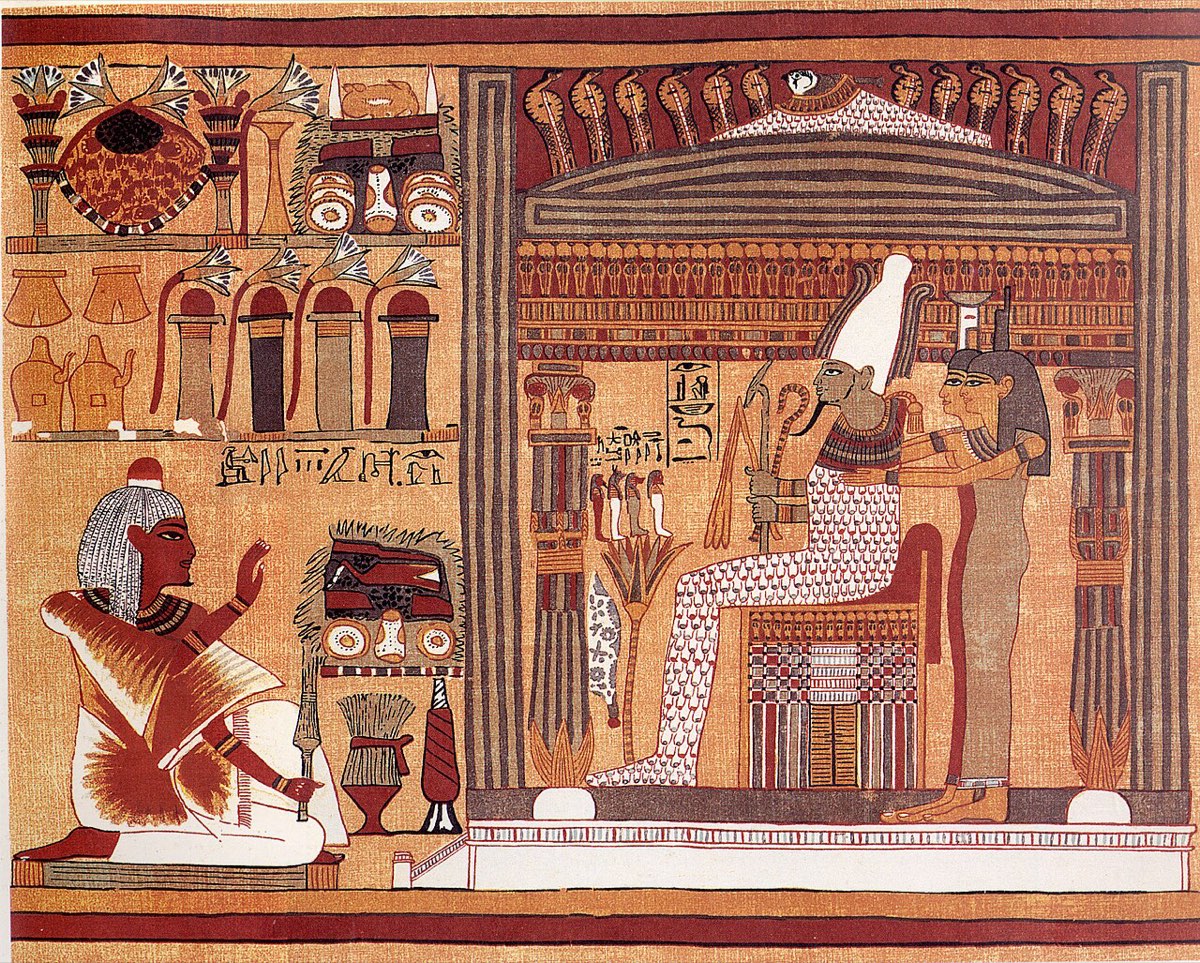
Osiris was one of the most popular gods of ancient Egypt, with a cult that endured for millennia, into the Greco-Roman era. He was seen as the god of vegetation, judgment, and the afterlife, and behind the apparent distance between these roles lies a single concept: the cycle of life and rebirth, shared by farming and the passage into the afterlife. Husband of Isis and father of Horus, he judged the dead in the “Hall of the Two Truths,” where the heart was weighed.
The version below was originally published with no source given. Since the Egyptians told the myth in different ways over the centuries, this is one narration among several, and it carries details that vary from others, such as the birth of Atum. The symbolic readings belong to the tradition and to the text, not to proven history.
From the abyss to the light
Before earth, sky, men, or gods, there was only Nun, a silent cosmic sea where everything rested as potential. Within it moves Apep, the serpent of the abyss, and, in this version, from her heart is born Atum, the first god. With him, the One becomes Two. In other traditions, Apep is the Egyptian personification of chaos, adversary of light and of Maat, order and truth.
Apep tries to swallow him back, as if wanting creation never to have happened. Atum transforms into the scarab, a symbol of transmutation, breaks through the abyss, and sets the world in motion.
Alone, he generates Shu, the air, and Tefnut, moisture, who become lost while exploring the limits of Nun. Atum sends his own eye to find them. When it returns, the eye, personified as a goddess, becomes enraged to see another in its place. The god calms her and sets her on his brow as the royal protector.
Atum then creates the first dry mound, which emerges from the waters. There lands Bennu, the original phoenix, who lays an egg shaped like a lotus. From the god's heart is born Ra, the sun, and time begins.
Sky and earth, pulled apart
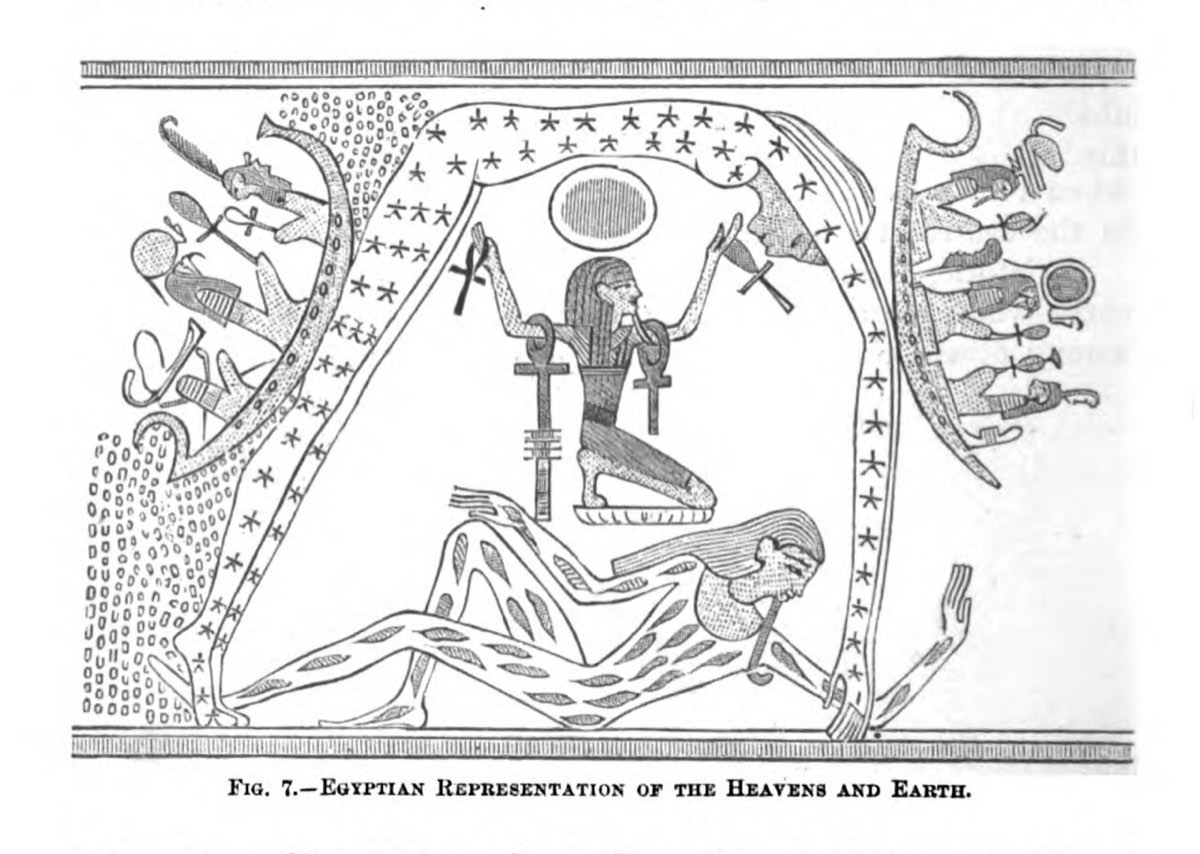
Shu and Tefnut have two children, Geb, the Earth, and Nut, the starry Sky. The two love each other so fiercely that the sky covers the earth entirely, leaving no room for anything. Atum orders Shu to lift Nut up, and it is in the gap opened between the lovers that life becomes possible.
From this separation are born five children: Osiris, linked to renewal and grain; Isis, the divine mother and goddess of magic; Nephthys, the obscure, silent sister; Set, god of chaos and the desert; and Horus the Elder.
The garden and the crime
Osiris and Isis form the couple of fertility. He is the grain, she the rain, and together they give rise to an Egypt watered by the Nile. Set, jealous, desires Nephthys and hates his brother's brilliance. In the myths, it is he who kills Osiris to seize the throne.
First, he destroys the garden with sandstorms and turns the black earth into desert. Then he cuts Osiris into pieces and scatters them across the country. Isis gathers them, with the help of Nephthys and Anubis, and embalms the body. Transformed into a bird, she flies over the corpse and conceives Horus, the son who will avenge him.
Horus against Set
Horus grows up in secret, discovers the truth, and confronts Set. Both take on other forms, one a falcon, the other a storm, and fight without a victor. Called in as judges, Thoth, god of knowledge, and Atum decide the dispute. Set makes one last attack, but Atum's solar eye drives him off.
Horus is crowned the first pharaoh of Egypt. With Isis, he performs the rite of the opening of the mouth on Osiris, restoring his breath of life. Osiris does not return to the world of the living and comes to reign over the underworld. His body remains in the black earth of the Nile, while his soul gives light to the dead. Every day, Ra enters the night, and in the morning is reborn.
The pharaoh, mirror of the myth
In the end, the narrative becomes royal rite. The pharaoh's soul is shaped on a divine potter's wheel. He is born from the queen's womb with a double nature, human, nursed by his mother, and divine, fed by Isis. Alive, he is Horus. Dead, he is Osiris, and his heir takes on the role of the new Horus.
In life, it falls to the pharaoh to make the Nile rise, fertilize the land, and cut the first sheaf. His heart is weighed on the scales of Maat. If he is just, he is vindicated and becomes light, united with Ra, Osiris, and Atum.
For the tradition that tells the myth, it is not merely a story, but the rhythm of the cosmos: every dawn repeats the birth of Ra, every harvest recalls the body of Osiris, and every death returns to Nun.
Sources and references for this article
Version of the Egyptian myth published on the Espaço Consciência blog (original source not given)
Osiris, Portuguese WikipediaApep (mythology), Portuguese WikipediaTranslated from Portuguese. This article was rewritten from a post on the original blog, in Portuguese. Read the original
Read next
 Western esotericismThe Eye of Horus: the documentary linking Egypt to Atlantis, and what Egyptology says
 Western esotericism · VideoThe Kybalion, chapter 1: a tradition from teacher to student, and what history says
 Vedanta and YogaGita, lesson 16: belief isn't knowledge, and the Veda as a mirror of the Self
 Vedanta and Yoga · VideoUpanishads: what the 108 texts underlying Indian philosophy are, and what they teach
 Western esotericism · VideoKabbalah in one hour: Gil Sheer's claim that it is a method, not a religion