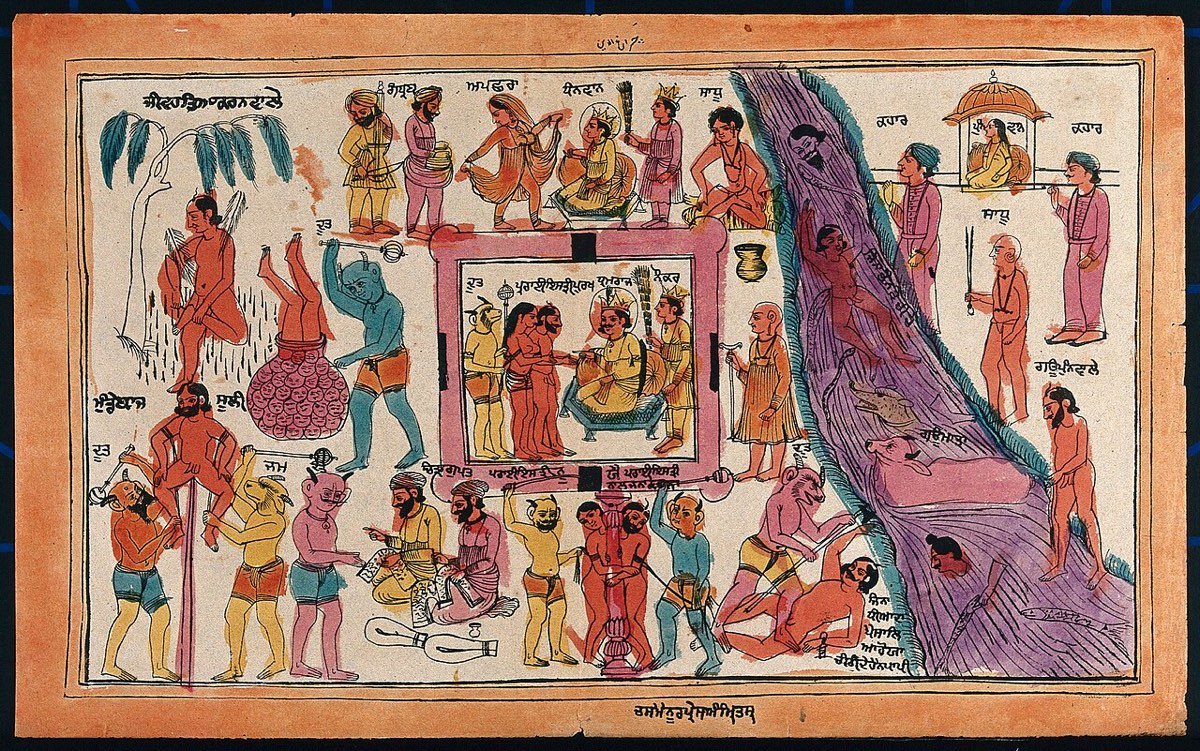
Thought in India: a UNED documentary travels through three thousand years of Hinduism
In 25 minutes, the series Sabidurías Orientales moves from the hymns of the Rig Veda and the Upanishads to Gandhi, Ramana Maharshi, Krishnamurti and Tagore.
· 2 min read · Sources
Source video
UNED Documentos · “El pensamiento en la india: Hinduismo”
More videos and documentaries in the Videos tabIn 1 minute
- Produced by UNED, Spain's public distance-learning university, the film presents Hinduism as a religion with no founder, no single book and no church.
- It reads passages from the Rig Veda, such as the creation hymn that ends in doubt, and from the Upanishads, with the teaching that the individual self and the absolute are one.
- It closes with the thinkers of modern India, from Ram Mohan Roy to Krishnamurti, as evidence that the tradition is still alive.
Full article
A primordial giant is sacrificed and, from his body, the world is born: from his mouth, the priests; from his arms, the warriors; from his thighs, the merchants; from his feet, the servants. The Purusha hymn, in the tenth book of the Rig Veda, is one of the entry points of El pensamiento en la India: Hinduismo, a 25-minute documentary from the series Sabidurías Orientales by UNED, Spain's public distance-learning university.
The series aired in 2003, with the participation of María Teresa Román López, professor of Eastern Philosophies at the university. The format is a narrated lecture, with images of India and readings of classical texts.
A religion without a center
The starting point is what makes Hinduism hard to explain to a Westerner: it has no founder, no official book like the Bible or the Quran, no dogma and no church. Believers themselves call it sanatana dharma, the eternal order or truth. The film describes it as a three-thousand-year laboratory where monism, polytheism, popular devotion and philosophy live side by side.
From the Vedas to the Upanishads
The script follows historical order. The Vedic hymns, attributed to seers said to have received them through inspiration, present a pantheon of gods of the sky, the atmosphere and the earth, from Indra to Agni. The creation hymn, the Nasadiya, is striking for its daring: it ends by admitting that perhaps not even the guardian of the heavens knows how it all began. Then come the Upanishads and their central thesis, the identity between Brahman, the absolute, and Atman, the individual self, illustrated by the dialogue in which a father shows his son the emptiness inside the seed of a fig tree. The Bhagavad Gītā enters with its image of the sage who receives desires the way the ocean receives rivers.
Modern India
The final part moves through the reformers and mystics of the 19th and 20th centuries: Ram Mohan Roy, Aurobindo, Gandhi, Ramakrishna, Vivekananda, Ramana Maharshi, introduced through the account of writer Paul Brunton, Krishnamurti and the poet Rabindranath Tagore.
Caveats
It is a 2003 film, with data from that time, and a necessarily quick overview. Some statements are simplifications, such as the claim that the caste system was the only trait of Indian culture immune to outside influence.
Why watch
As an introduction. In a short time, and with passages from classical texts read aloud, the documentary gives viewers a map of where ideas now circulating in yoga and meditation come from, and shows that the tradition did not stop with the ancient books.
Sources and references for this article
El pensamiento en la india: Hinduismo. UNED Documentos, YouTube, 1 Jun 2017El pensamiento en la India: Hinduismo, video page on Canal UNEDHinduism, Wikipedia (in Portuguese)Nasadiya Sukta, WikipediaGet the best articles of the week
One email a week, no spam. Unsubscribe anytime.
Read next
 Vedanta and Yoga · VideoWhat Dies When Someone Dies? The Answer from Ramana Maharshi and Advaita Vedanta
 Vedanta and Yoga · VideoHistory of Yoga: the documentary that searches for yoga across six thousand years of Indian history
 The East · VideoUrgan, the boy monk of the Himalaya: documentary follows a nine-year-old's journey to the monastery
 The East · VideoKrishnamurti on freedom: no guru, no method and no conflict
 Vedanta and Yoga · VideoNachiketas and Death: what the Upanishads teach about the eternal Self and immortality