Gita, lesson 4: the inevitable war and the master in the chariot
The fourth lesson shows how the royal family's quarrels lead to war, and how Krishna, without fighting, takes Arjuna's place as charioteer.
· 1 min read · Sources

In 1 minute
- Dayananda reads the Mahābhārata as the story of a family that destroys itself through pride, blindness and a lack of reflection.
- The Pāṇḍavas asked for less and less, down to five houses, and the refusal made war inevitable.
- Krishna, who does not fight, drives Arjuna's chariot, an image of the master who guides the disciple through crisis.
Full article
If the Bhagavad Gita opens in the middle of a battle, it is because something failed long before it. The fourth lesson in Swami Dayananda Saraswati's series retraces that path, and what it reveals about the human mind.
A tragedy born of not thinking
The Mahābhārata is a drama of brothers who turn against each other out of pride, vanity and decisions made without reflection. Rather than simple heroes and villains, there is a family that destroys itself by acting on impulse. King Dhṛtarāṣṭra, blind from birth, is also read as someone blind by choice. His wife, Gāndhārī, blindfolded herself. In Dayananda's reading, the parents' absence of true sight weighed on how their sons, the Kauravas, were raised.
The refusal of minimal justice
The Pāṇḍavas tried to avoid the conflict. They asked for half the kingdom, then five districts, then five villages, and finally a single village with five houses. All of it was denied. Krishna, sent as a messenger of peace, was rejected too. At that point, in the tradition's reading, war stops being a choice and becomes what dharma, right conduct, demands.
Krishna at the reins
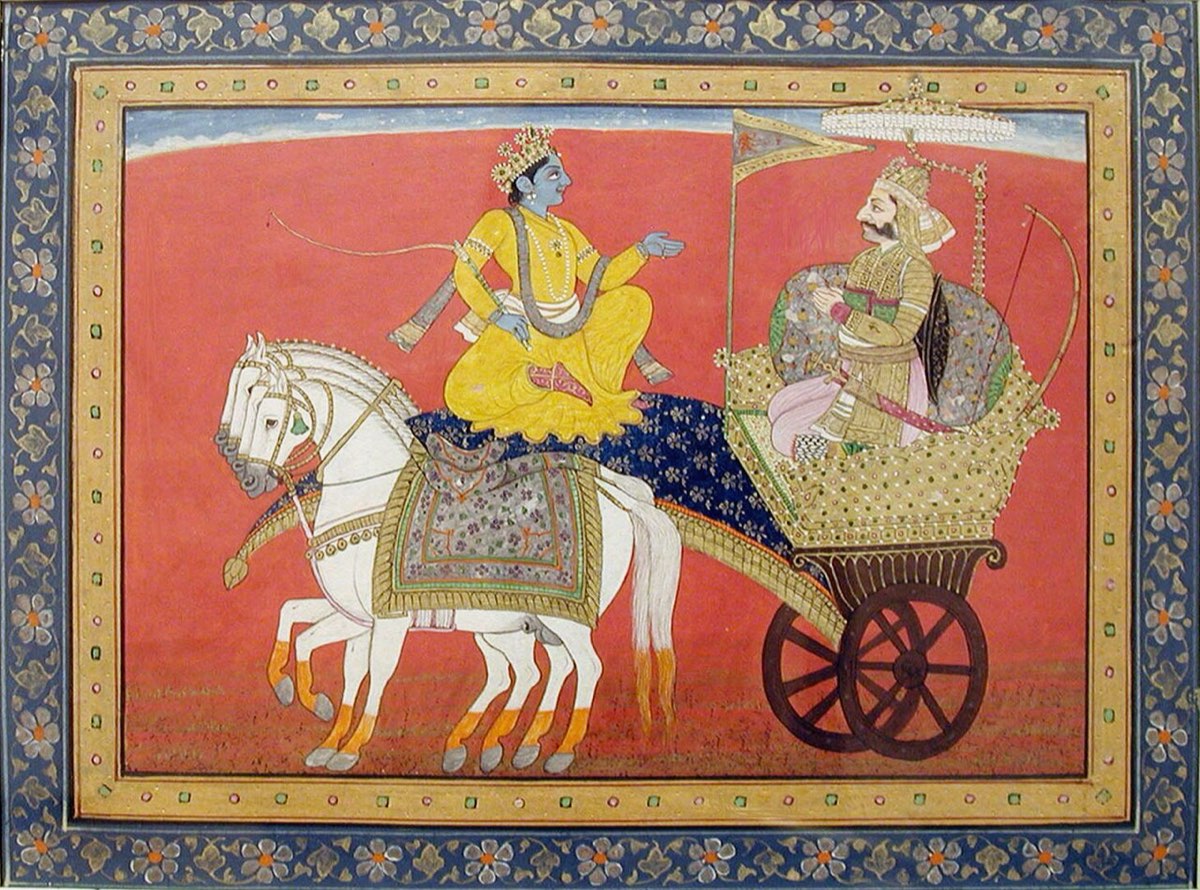
Krishna offers Arjuna two options: his army or his own presence, without fighting. Arjuna chooses his presence. Krishna becomes the charioteer, and the scene turns into an image of teaching itself. The confused seeker sits behind; the master drives with firmness and discretion.
The discouragement that lives in the mind
There is also Śalya, Arjuna's uncle, who discourages the others and whom Dayananda reads as the inner voice saying it won't work out. The Gita, in that sense, is the conversation that helps one move through that block.
The battlefield is also a field of self-knowledge: the enemy to overcome is the confusion of the ego and doubt, more than the opponents outside.
The full study is in the book The Essence of the Bhagavad Gita, by Swami Dayananda Saraswati.
Sources and references for this article
The Essence of the Bhagavad Gita, Swami Dayananda Saraswati (book)
Translated from Portuguese. This article was rewritten from a post on the original blog, in Portuguese. Read the original
Read next
 Vedanta and YogaThe value of values: why Vedānta begins by preparing the mind
 Vedanta and YogaConsciousness with a body: what Vedānta says the “self” is
 Science and consciousnessVedānta and quantum physics: what the observer has to do with reality
 Western esotericismA Hermetic manifesto against "selective blindness": mind, ether, and archons
 Vedanta and Yoga · VideoWhy pride keeps people from faith: a reflection on the emptiness of living "well"