How Allan Kardec tested spirit messages and assembled the Spiritist codification
An educator, Kardec devised tests of reason, agreement among mediums, and morality for spirit messages, and organized Spiritism in five books (1857-1868).
· 4 min read · Sources

In 1 minute
- Hippolyte Léon Denizard Rivail, known as Allan Kardec, approached the turning tables as a skeptical pedagogue and treated messages attributed to spirits as information to be tested.
- His method combined reason, agreement among independent messages (the Universal Control of the Teaching of the Spirits), the morality of whoever communicates, and distrust of fraud.
- The codification appeared between 1857 and 1868 across five books; Spiritism is both doctrine and religion, and communication with the dead has not been demonstrated by science.
Full article
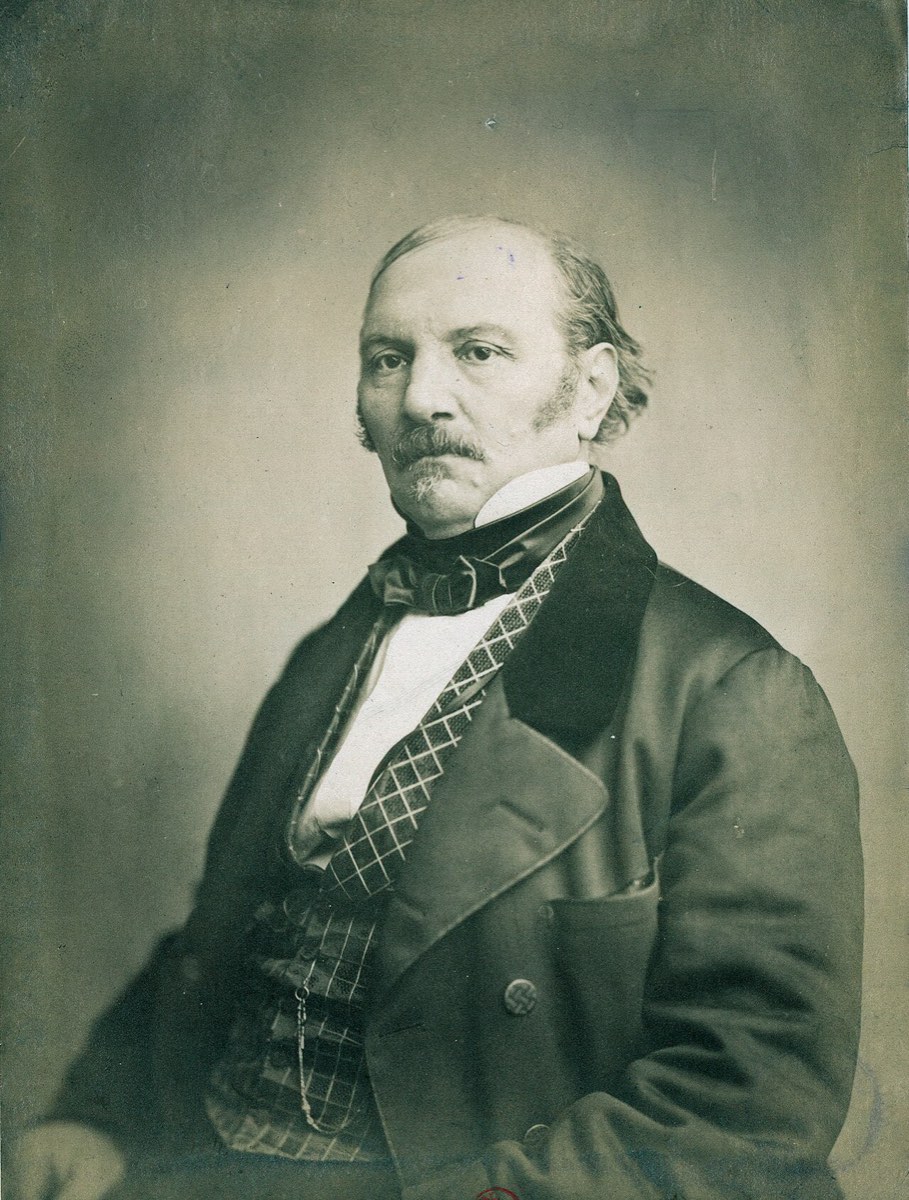
In the early 1850s, turning tables were parlor entertainment and newspaper fodder across Europe. The fad began in the United States with the Fox sisters in 1848, crossed the Atlantic in 1852, and became enormously popular in France. A Parisian educator, Hippolyte Léon Denizard Rivail, went to see them with skepticism. What he concluded, and how he got there, gave rise to Spiritism, a doctrine he would present to the world under the pen name Allan Kardec.
What makes the case interesting, even for those who don't share the belief, is the method. Kardec insisted on treating messages attributed to spirits as information to be tested, not revelation to be accepted. This piece describes that method and the body of work that came from it, from a Spiritist point of view. The claim that there is communication with the dead has not been demonstrated by science, and Spiritism itself is not recognized as a science, though Kardec defined it as a doctrine that unites scientific, philosophical, and religious aspects.
From pedagogue to investigator
Kardec was born in Lyon in 1804 and died in Paris in 1869. According to Spiritist sources, his training as an educator, shaped by the Swiss pedagogue Johann Heinrich Pestalozzi, molded his investigation. He wasn't satisfied with the curious surface of the phenomena: he sought an intelligent cause behind the effects. Working back from effects to causes is a classic step of the scientific method, applied here to an unusual subject.
The rule attributed to him was to observe, compare, and judge. His goal went beyond knowledge: he spoke of forming the "man of good," joining learning to moral transformation.
Three criteria for validation
The first filter was reason. Any communication, whether of human or spiritual origin, had to pass the test of logic and common sense, and whatever contradicted established scientific facts would be rejected. The intent was to avoid blind faith.
The second, which Kardec considered the most important, is the Universal Control of the Teaching of the Spirits. In the first stage, the living compare any new teaching with what is already established, including the sciences. In the second, when the spirits judge a new principle necessary, it would be transmitted spontaneously to several mediums who don't know one another. Agreement among independent sources would grant authenticity to the teaching and keep authority from resting with a single revealer.
The third looks at who is speaking. Elevated spirits would reveal themselves through dignified, clear, concise language, free of contradiction on essential matters, and through humility and benevolence. Vulgar, pretentious, or contradictory language would expose inferior spirits or impostors. In this scheme, ethics is part of validation.
Against fraud
In The Book on Mediums (1861), Kardec devoted chapters to contradictions, hoaxes, and charlatanism. He described tricks capable of imitating physical phenomena, such as knocks, direct writing, and the transport of objects, and recommended distrusting whatever was obtained too easily, on demand. He saw in a medium's material disinterest and lack of vanity the best guarantees against deception. The concern also served the movement's credibility, which depended on separating rigorous study from superstitious or exploitative practices.
The codification, step by step
The starting point is April 18, 1857, with the publication in Paris of The Spirits' Book, organized as questions from Kardec and answers attributed to spirits, received through several mediums, among them the young Caroline and Julie Boudin. In 1858, Kardec founded the Paris Society for Spiritist Studies and launched the monthly Revue Spirite. The society functioned as a laboratory of sessions and debate; the magazine, as a space to test ideas and gather reactions before fixing them in books. The second edition of The Spirits' Book, from March 18, 1860, was considerably expanded, with 1,018 questions, after consultations with groups from roughly fifteen countries.
The five foundational works, the Kardecian Pentateuch, are rounded out by What Is Spiritism? (1859), The Book on Mediums (1861), The Gospel According to Spiritism (1864), Heaven and Hell (1865), and Genesis (1868). A posthumous collection, Posthumous Works, appeared in 1890.
Opposition, dissent, and a Spiritism in motion
The Catholic Church condemned the doctrine for its defense of reincarnation and communication with the dead. On October 9, 1861, in Barcelona, three hundred volumes of Spiritist works were burned by order of the local bishop, and The Spirits' Book entered the Index of Forbidden Books in 1864. The scientific community of the time attributed the phenomena to fraud, hallucination, or unknown physical forces. There was also an internal risk: in Posthumous Works, Kardec foresaw schisms caused by the vanity of those who wanted to attach their name to some innovation.
Kardec defined Spiritism as "essentially progressive." In the Spiritist reading, this means the doctrine must keep pace with science and correct itself if a discovery contradicts it, and that new teachings are admitted only after the control of agreement. Today's Spiritist institutions, such as CCDPE-ECM, sum up the continuity of the work in three strands: faithful study of the works, careful research, and social action driven by charity. They cite as challenges the distorted information online and practices carried out for money under the Spiritist label.
What runs through all of it is the idea that method matters as much as conclusions: neither blind credulity nor starting skepticism, but the demand that a message withstand questioning.
Sources and references for this article
O que é o controle universal da doutrina espírita?, blog IDEAKCCDPE-ECM, Centro de Cultura, Documentação e Pesquisa do EspiritismoAllan Kardec e o progresso da ciência, DialnetText on Kardec, Luz EspíritaO Livro dos Espíritos, Federação Espírita BrasileiraAllan Kardec, WikipediaSpiritism, WikipediaO Livro dos Espíritos, WikipediaTranslated from Portuguese. This article was rewritten from a post on the original blog, in Portuguese. Read the original
Read next
 Death and beyondKardec, Socrates, and Plato: the morality of Christ separated from dogma in the Spiritist Gospel
 Death and beyond · VideoAllan Kardec's “testament”: what is known and what is narrative
 Vedanta and YogaGita, lesson 20: consciousness isn't in the world, the world is in it
 Accounts and channelings · VideoAkashic Records: where the idea of a universal memory comes from, and how to access it
 Death and beyond · VideoWhat souls do after death, in a Spiritist view: work, study, and service