Born again: why Kardec sees reincarnation in Jesus's talk with Nicodemus
For Kardec, Jesus's words to Nicodemus speak of reincarnation, which he says makes sense of divine justice, life's inequalities and bonds of affection.
· 3 min read · Sources

In 1 minute
- Kardec reads the “born again” of John's Gospel as reincarnation, which he distinguishes from resurrection as the Spirit's return in a new body.
- His arguments are Jesus's words about John the Baptist and Elijah, and the idea that only multiple lives explain inequality and preserve bonds of affection.
- Reincarnation is a principle of Spiritist doctrine, not a proven fact, and Kardec's reading of the Gospel is one interpretation among others.
Full article
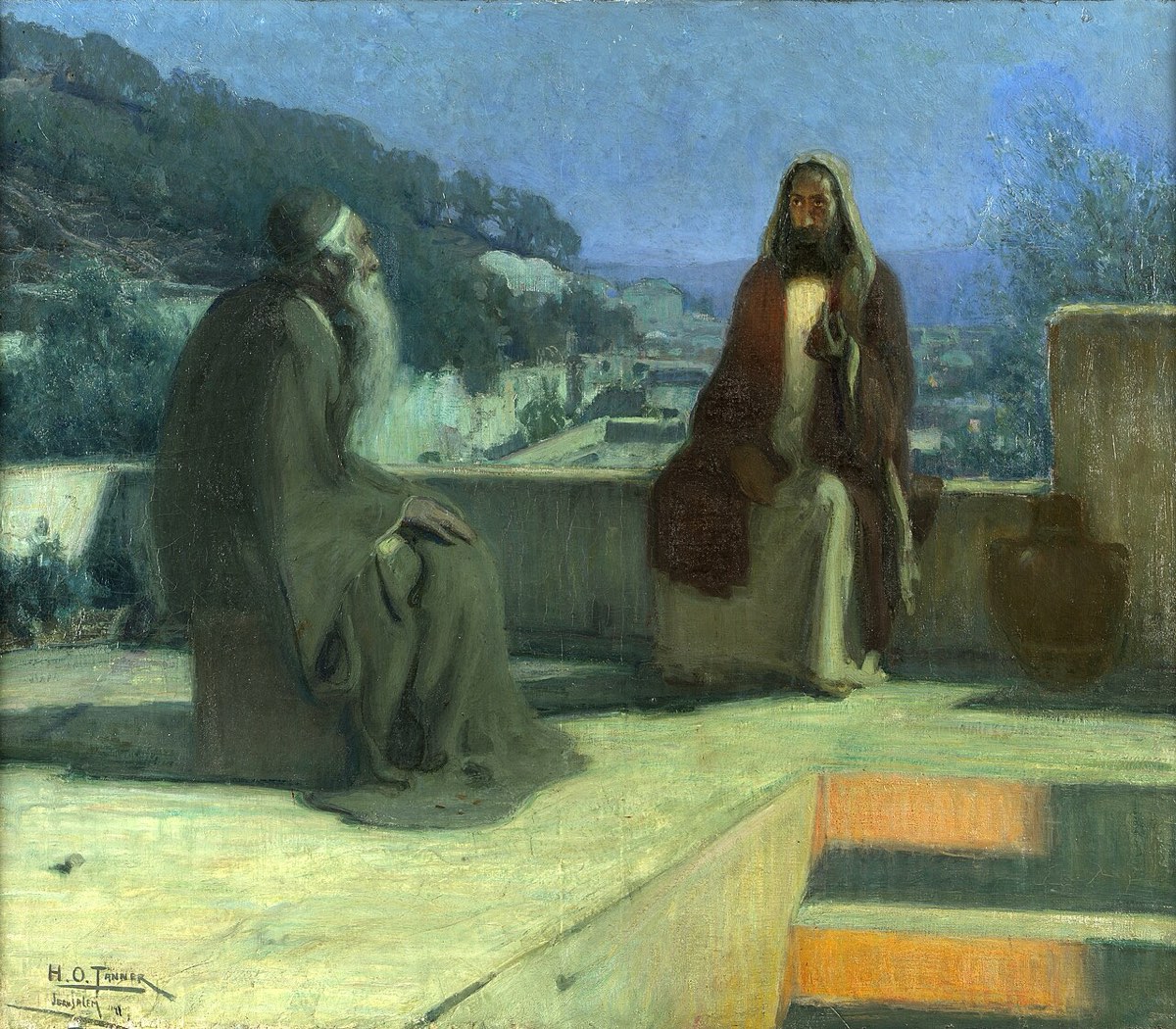
In a nighttime conversation with Nicodemus, a leader of the Jews, Jesus says, according to the Gospel of John, that no one can see the kingdom of God without being born again. Theologians have debated for centuries what that means. In chapter 4 of The Gospel According to Spiritism, Allan Kardec answers that the phrase speaks of reincarnation, and that the idea is not modern but was already present in Christ's teaching.
Reincarnation is a principle of Spiritist doctrine, which treats it as truth and which cannot be proven.
Reincarnation is not resurrection
Kardec notes that among the Jews, belief in a return to life existed in a vague form, mixed with the idea of resurrection. He separates the two. Resurrection would mean the same physical body returning, which the chapter considers impossible. Reincarnation is the Spirit's return to bodily life in a new body, with no material link to the previous one. By this distinction, John the Baptist could be Elijah reincarnated, but not Elijah resurrected.
John the Baptist and Elijah
The main scriptural support is Jesus's statement, in Matthew 11:14, that John the Baptist is the Elijah who was to come. For Kardec, the phrase leaves no room for a purely symbolic reading: Jesus confirms reincarnation as a legitimate principle of his teaching. And if it had been a popular error, Kardec argues, Jesus would have corrected it rather than endorse it before everyone.
The same holds for the dialogue with Nicodemus. Jesus says that whoever is not born of water and of the spirit will not enter the Kingdom of God. Kardec interprets water as material nature, the body, and spirit as intelligent nature. To be born of both would be to be reborn with body and soul, that is, to reincarnate.
The key to justice
The philosophical argument is that only the plurality of existences makes sense of life's inequalities: children born into suffering, differences in talent and character, good people facing painful trials. Without it, Kardec says, these apparent injustices would be unsolvable. With it, everything fits into a law of cause and effect, merit and reparation. Hence the chapter's claim that, without plurality of lives, most of the Gospel's maxims would be unintelligible.
The bonds that survive
One of the most affecting parts deals with the relationships between people. According to Kardec, bonds of true affection are spiritual and survive death. Kindred Spirits would form families in the beyond and meet again across successive incarnations. The idea of a single life, by contrast, dissolves those bonds, and only reincarnation would guarantee that parents, children, spouses and friends can reunite beyond this world.
Kardec compares the various systems on the soul and concludes that only reincarnation preserves individuality, allows for infinite progress, gives meaning to divine justice and strengthens family and social bonds.
A stage, not a punishment
For the Spirits cited in the chapter, incarnation is not an absolute punishment but a necessary stage of progress, an educational task rather than a sentence. It would vary from world to world. In lower worlds it would be heavy, dense and prone to pain. In more advanced ones, bodies would be light, almost ethereal, with greater spiritual freedom.
The chapter closes by saying that reincarnation accounts for the soul's entire journey, reads suffering as reparation, clarifies how moral progress happens and grounds fraternity among all. The Spirit, in the doctrine's view, is eternal and free, and its path is made of many births, lessons and reunions. Whoever denies the plurality of existences, Kardec states, denies Christ's own words.
Sources and references for this article
Allan Kardec, The Gospel According to Spiritism, chapter 4
The Gospel According to Spiritism, Wikipedia (published in Paris, April 15, 1864)Allan Kardec, WikipediaTranslated from Portuguese. This article was rewritten from a post on the original blog, in Portuguese. Read the original
Read next
 Death and beyondKardec, Socrates, and Plato: the morality of Christ separated from dogma in the Spiritist Gospel
 Death and beyondHow Allan Kardec tested spirit messages and assembled the Spiritist codification
 Western esotericism · VideoApocryphon of John: Barbelo, Sophia and the false god, in the Gnostic text from Nag Hammadi
 Western esotericism · VideoThe Apocryphon of John, the Gnostic text where the world is born of a flaw
 Death and beyond · VideoWhat souls do after death, in a Spiritist view: work, study, and service